Go Back
+ servings
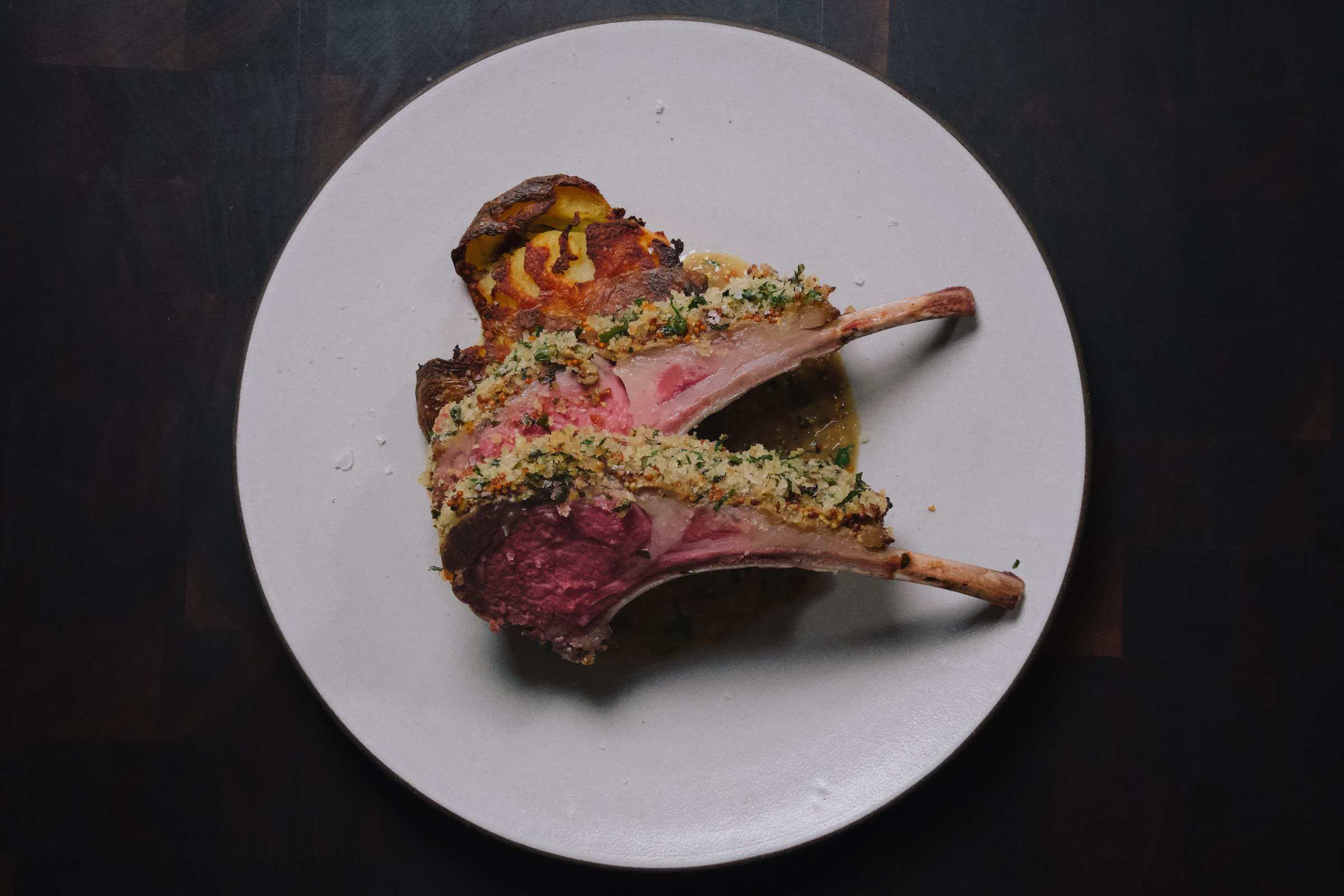
Two lamb chops sliced from a rack, a herb and mustard crust along the top edge, rare in the middle, on a white plate with pan sauce and a crisp smashed potato.

Herb Crusted Rack of Lamb with Mustard Pan Sauce

No ratings yet
A whole rack of lamb, fat cap on and scored, salted overnight and rendered from a cold cast iron pan. Whole grain mustard and herb crumbs pressed onto the rendered cap, a mustard pan sauce built in the fat that came off it, and smashed potatoes roasted in the same fat.
Prep Time 20 minutes
Cook Time 40 minutes
Total Time 1 hour
Servings: 3
Course: Entree, Meat
Cuisine: American, French

Ingredients
  

Lamb
  • 1 rack of lamb 7 to 8 ribs, about 1 ½ to 2 lb, fat cap on
  • 2 teaspoon Diamond Crystal kosher salt about a teaspoon per pound
  • 2 sprigs rosemary
  • 3 cloves garlic smashed
Mustard Herb Crust
  • 2 tablespoon whole grain Dijon mustard
  • ½ cup panko
  • 2 tablespoon flat-leaf parsley finely chopped
  • 1 tablespoon mint finely chopped
  • 1 teaspoon thyme leaves
  • 1 tablespoon olive oil
  • ¼ teaspoon Diamond Crystal kosher salt
Mustard Pan Sauce
  • 1 large shallot finely diced
  • ½ cup dry white wine
  • ½ cup chicken stock
  • 2 tablespoon whole grain Dijon mustard
  • 3 tablespoon unsalted butter cold, cubed
  • 1 tablespoon flat-leaf parsley chopped
  • lemon a squeeze
Smashed Potatoes in Lamb Fat
  • 1 ½ lb small Yukon Gold potatoes whole, skin on
  • 1 teaspoon baking soda for the boiling water
  • Diamond Crystal kosher salt a big handful, for the boiling water
  • the rendered lamb fat poured off the pan
  • the rosemary and garlic out of the pan
To Serve
  • flaky salt

Method
 

The Night Before
  1. Score the fat cap in a shallow crosshatch, about ¼ inch apart. Cut through the fat and stop before the meat. The cuts keep the cap flat against the iron instead of contracting and doming, and they shorten the trip the fat has to make to get out. Score before you salt, so the salt lands down in the cuts and not just on top of them.
  2. Salt the rack all over, fat cap, meat side, both cut ends and in between the bones. You should be able to see individual grains sitting on the surface from a foot away, not a heap and not a dusting that disappears when it lands. A good part of what the scale reads is bone, so salting to that number over-seasons the meat that is actually there.
  3. Set it on a rack over a tray, uncovered, in the fridge overnight. The salt works its way in and the surface dries out, and a dry surface is the only thing that browns. Overnight, or salt it as it hits the pan. Nothing in between: forty minutes pulls the water out and gives it no time to go back.
Mise
  1. Mix the panko, parsley, mint, thyme, olive oil and salt in a bowl. Dice the shallot. Both need to be ready before the rack comes out of the pan, because the crust goes on hot.
  2. Parboil the potatoes, skin on, in water with a big handful of salt and a teaspoon of baking soda. The alkaline water breaks down the pectin holding the outside of the potato together and releases a layer of starch, and that is what goes crisp later. Start checking at twelve minutes. A knife should go in with no resistance.
  3. Pour the water off and put the pot back on the residual heat, lid off, until the steam stops and the surfaces go chalky. A dry surface fries. A wet one steams.
  4. On a board, press each potato flat under another pan into a rough puck, about an inch thick, while they are hot. Heat the sheet pan in the oven empty while the lamb renders, and slide the pucks onto it hot.
Render, Then Sear
  1. Straight out of the fridge into the pan. The cold center buys you time to render the cap fully before the middle climbs past where you want it.
  2. Stand the rack fat cap down in a cold cast iron pan, set it over medium heat, and leave it alone. It is loud at first, and that noise is water leaving the fat. When the pan goes quiet, the water is gone and the fat is browning. You want the cap glassy brown, giving under a thumb, with a shallow pool of lamb fat around it. A thin cap on a small rack gets there quickly. A thick one can take twice as long, so go by the sound and the colour, not the clock.
  3. This step is the dish. Lamb fat is still solid at the temperature of your mouth, so fat that has not rendered coats the palate and stays there. That is what people mean when they say they do not like lamb.
  4. Tip the rack onto one rib side, 60 to 90 seconds in the fat that is already there, then the other side. The meat between the bones has been standing in the air the whole render with no heat on it at all. It goes from soft to firm and the cut edges curl and colour.
  5. Turn the rack onto its meat side and sear two minutes in the fat it just gave up. Rosemary and garlic into the pan for the last thirty seconds.
Crust and Roast
  1. Lift the rack out. Pour the excess rendered fat over the potatoes on the hot sheet pan and toss, keeping about 2 tablespoon in the cast iron for the sauce. The rosemary and the smashed garlic go in with them.
  2. Wait until the cap has stopped hissing and feels tacky rather than slick, then brush the mustard over it and press the herb crumbs in. The mustard is the only thing in this recipe that will hold a crust on a piece of meat, and the rendered cap is why it grips instead of sliding off greasy fat.
  3. Rack back in the cast iron, crust side up, potatoes on their own pan beside it. Roast at 375°F until the thickest part of the lamb reads 125°F. Around fifteen minutes, but go by the thermometer. Thickness sets this, not the clock.
  4. Lift the rack onto a board to rest, crust side up. Turn the oven up to 450°F and leave the potatoes in it. Leave the cast iron and everything in it alone.
  5. Build the sauce while it rests. That is the rest: the lamb sits on the board the whole time the sauce is coming together, and it will read 133 to 135°F by the time you slice it. Flip the potatoes once, when the undersides are deep brown and they lift off the pan without holding on. They are done when the edges have gone dark and lacy.
The Sauce, While It Rests
  1. Pour off all but about 2 tablespoon of the rendered fat, keeping the browned bits. Pan back on medium. Shallot in, two minutes, until soft and translucent.
  2. Wine in. Scrape everything off the bottom and let it reduce until the pan is almost dry. Stock in, reduce by half.
  3. Off the heat. Whisk in the mustard, then the cold butter a cube at a time until the sauce is glossy. Boiling flattens the mustard and splits the butter, which is why both go in off the heat, mustard first. Parsley, lemon, salt to taste.
Serve
  1. Slice down between the bones into chops. Spoon the sauce onto the plate and set the chops on top, crust side up. Sauce over the crust turns the crumb soft in under a minute.
  2. Potatoes alongside, flaky salt over everything. Warm the plates if you can: lamb fat sets hard again on a cold one.

Notes

For seasoning, I always use Diamond Crystal kosher salt. If you use Morton, use half.
The overnight salt is inactive time and is not counted in prep or cook.
The mustard does two different jobs and both depend on the render. On the cap it is glue, the only thing that holds a crumb onto meat. In the pan it is the emulsifier that pulls the fat and the stock into one sauce. Skip the render and neither works, because there is nothing for the crust to grip and nothing in the pan to build on.
Buy the thickness, you cannot make it at the stove. A whole rack is thick by definition, which is what lets the cap render and the middle stay pink at the same time.
Leave the cap on. That is the one thing to ask for. Having the first inch of the bones cleaned up is normal, it is what most butchers do anyway, and it costs you almost nothing. Trim only the hard waxy lumps at the edges that were never going to melt.
The USDA says 145°F. That is a safety floor, not a target, and it lands past the point where the muscle tightens.
On a thin chop, drop the crust and keep the sauce. You cannot press a crumb onto a half-inch chop over coals, but the sauce works on any of it.

Tried this recipe?

Let us know how it was!